
Sorting JSON Keys Alphabetically
Quick answer: Sorting an object's keys alphabetically makes JSON deterministic — the same data always serializes the same way. That means smaller git diffs, fewer merge conflicts, and stable hashes for caching or signatures. Key order has no effect on the data's meaning, so sorting is safe. Sort and reformat in one step with the JSON Formatter.
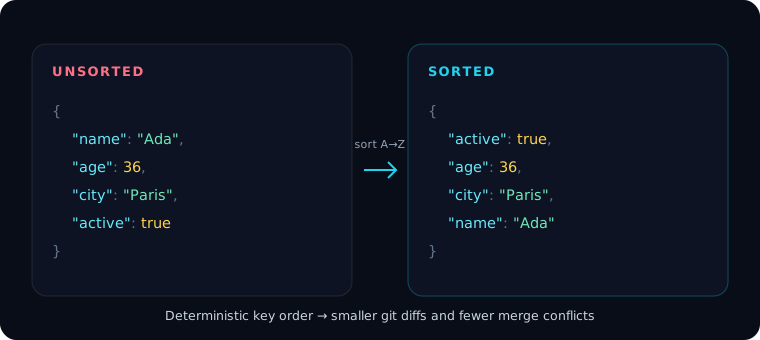
Why order doesn't change meaning — but still matters
JSON objects are unordered by definition: {"a":1,"b":2} and {"b":2,"a":1} represent the same data, and parsers treat them identically. So sorting keys never changes what the JSON means.
What it changes is the text. And a lot of tooling cares about the text:
- Git diffs. If two processes emit the same config in different key orders, every line looks changed. Sorted keys mean a diff shows only the values that actually changed.
- Merge conflicts. Deterministic order keeps unrelated edits from colliding.
- Hashes and signatures. Caching keys, ETags, and signed payloads depend on byte-for-byte stable output. Reorder the keys and the hash changes even though the data didn't.
- Findability. In a large config, alphabetized keys are simply faster to scan.
How to sort
In the browser: paste into the JSON Formatter to sort keys and pretty-print (or minify) in one pass.
In JavaScript, a recursive sort that handles nested objects:
function sortKeys(value) {
  if (Array.isArray(value)) return value.map(sortKeys);
  if (value && typeof value === "object") {
    return Object.fromEntries(
      Object.keys(value).sort().map((k) => [k, sortKeys(value[k])])
    );
  }
  return value;
}
JSON.stringify(sortKeys(data), null, 2);
In Python, the encoder has it built in:
import json
json.dumps(data, sort_keys=True, indent=2)
Note that sorting recurses into nested objects but must not reorder arrays — array order is meaningful data, unlike object key order.
When not to sort
- When key order is intentional for humans. A config grouped by concern (server settings together, then logging) can read better than alphabetical. Sorting flattens that intent.
- Inside arrays. Never sort array elements as a side effect — that changes the data. Only object keys are safe to reorder.
For a canonical, byte-stable form used in signing, sorting keys is one half of "canonical JSON"; the other half is consistent whitespace — see Pretty vs Minified JSON. To confirm two documents are equivalent regardless of key order, use the JSON Diff Viewer.
Frequently asked questions
Does sorting JSON keys change the data? No. JSON objects are unordered, so reordering keys doesn't change the data's meaning. It only changes the serialized text, which is what tools like git and hashers see.
Why sort JSON keys at all? To make output deterministic: smaller diffs, fewer merge conflicts, and stable hashes for caching or signing. It also makes large objects easier to scan.
Does sorting reorder array elements too? It should not. Array order is meaningful data. Sort only object keys; recurse into arrays to sort the keys of objects inside them, but leave element order alone.
How do I sort keys in Python or JavaScript?
In Python, json.dumps(data, sort_keys=True). In JavaScript, sort Object.keys() recursively and rebuild the object, or use a tool like the JSON Formatter.
Related tools
Related lessons