
Big Numbers in JSON: Avoiding Precision Loss
Quick answer: JavaScript numbers are IEEE-754 doubles, exact only up to 2⁵³ − 1 (9007199254740991). A larger integer in JSON — a 64-bit ID, a Snowflake, a bigint primary key — silently loses precision when parsed, changing its value. The fix is to send big integers as strings (or use a BigInt-aware parser). Inspect suspect payloads in the JSON Debugger.
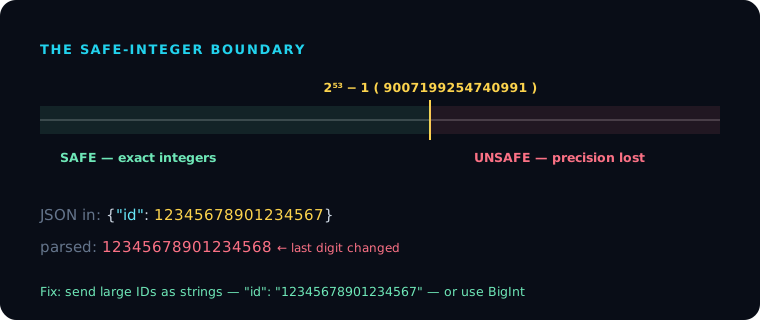
Why the value changes
JSON's number type is just "a number" — the spec doesn't fix a precision. But JavaScript represents every number as a 64-bit float, which can only hold integers exactly up to Number.MAX_SAFE_INTEGER (2⁵³ − 1). Beyond that, parsing rounds to the nearest representable double:
JSON.parse('{"id": 12345678901234567}').id;
// → 12345678901234568   (last digit changed!)
Nothing throws. The data is just quietly wrong — the worst kind of bug, because it surfaces far from its cause.
Where this bites
Real-world IDs routinely exceed 2⁵³:
- Twitter/X Snowflake and Discord IDs (64-bit).
- PostgreSQL
bigintprimary keys. - Stripe-style or UUID-derived integer identifiers.
- Financial values stored in the smallest unit (cents/satoshis) for very large amounts.
If any of these flow through JavaScript as JSON numbers, comparisons and lookups can fail because the ID no longer matches.
The fix: strings or BigInt
Send big integers as strings in the JSON. This is the most portable solution — every language reads a string losslessly:
{ "id": "12345678901234567", "balanceCents": "99999999999999999" }
Your code converts to BigInt only when it needs arithmetic. BigInt (ES2020) gives JavaScript arbitrary-precision integers:
const id = BigInt("12345678901234567"); // exact
If you can't change the payload to strings, use a BigInt-aware JSON parser (e.g. a json-bigint library) that parses large integers into BigInt instead of number. Note that JSON.stringify doesn't serialize BigInt by default — convert it back to a string when sending.
Floats lose precision too
The same IEEE-754 limit affects decimals: 0.1 + 0.2 !== 0.3. For money, don't store dollars as floats — store integer cents (as strings if large), or use a decimal library. For the broader rules on JSON's scalar types, see The Six JSON Data Types, and on serialization behavior, Parse and Stringify.
Frequently asked questions
Why does my big number change when I parse JSON?
JavaScript stores numbers as 64-bit floats, exact only up to 2⁵³ − 1. Larger integers are rounded to the nearest representable value during JSON.parse(), so the value changes silently.
What's the safe integer limit in JavaScript?
Number.MAX_SAFE_INTEGER, which is 2⁵³ − 1 = 9007199254740991. Integers above this can't all be represented exactly as doubles.
How do I send a 64-bit ID in JSON safely?
Send it as a string ("id": "12345..."). Every language parses strings losslessly. Convert to BigInt in code only if you need to do math on it.
Does this affect other languages besides JavaScript? The risk is worst in JavaScript because all numbers are doubles. Languages with native 64-bit integers can parse them fine — but if a JavaScript client is anywhere in the chain, strings are the safe choice.
Related tools